

- Télécharger en PDF
-
Partager cette page
- Télécharger en PDF
- Erasme,
- Aurora,
- Recherche,
Appel à communications : Deuxième conférence UNIDELIB
Publié le 27 janvier 2026
Call for paper : 2nd conference of deliberating Universities Network unidelib
Date(s)
du 27 janvier 2026 au 27 février 2026
Lieu(x)
Fontainebleau
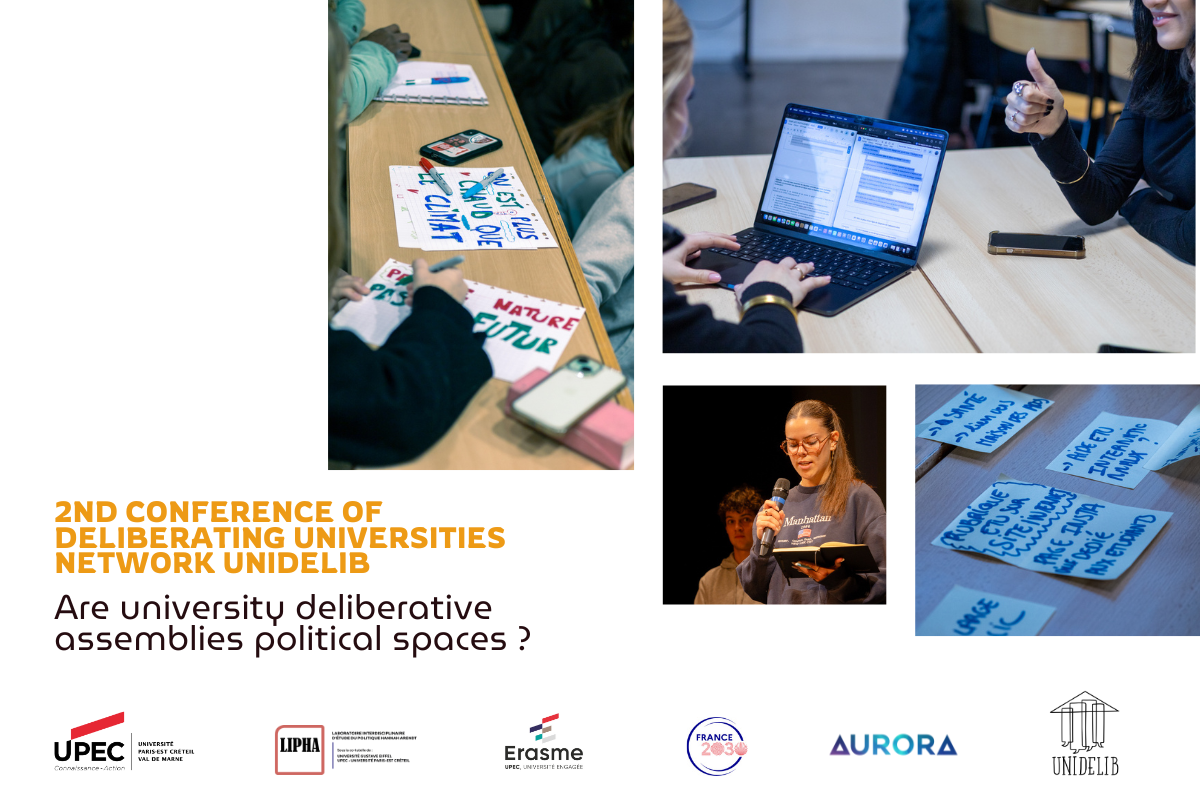
The UNIDELIB network of deliberative universities is organizing its second international conference on June 15, 2026, in Fontainebleau, at the Institut d'Etudes Politiques of the Université Paris Est Créteil (UPEC). The aim of this day is to take time to reflect on the political nature of the deliberative assemblies organized in several universities in the network and elsewhere since 2020. Despite the transformative ambitions of these mechanisms for university functioning, are they in fact political spaces? Here, political space is taken in the broad sense of having a transformative capacity, however minimal, on the balance of power within the university governance system, the policies adopted, and/or the participants themselves. Alternatively, are they more accurately considered educational spaces capable of supporting students and staff in learning how to deliberate and/or explore certain collective issues related to the functioning of the university? Or even as mechanisms that are particularly useful for social science research? That would be a less ambitious but perhaps more realistic goal.
The goal of this conference is to refine our understanding of how the university's space, hierarchies, budgetary constraints, and daily practices affect the deliberative mechanisms within it. This will clarify the expectations and ambitions surrounding these mechanisms.
We are launching this Call For Papers within the member universities of the network, but also outside it, and we welcome proposals that shed light on any aspect of these issues. The disciplines of sociology, political science, education science, urban studies, anthropology, philosophy, social psychology, environmental studies and history are particularly targeted, but proposals from other disciplines may also be considered. The deadline for applications is Friday, February 27th. Proposals should be sent by email to selma.tilikete@u-pec.fr and chloe.santoro@u-pec.fr
Since 2020, there has been a proliferation of experiments with deliberative assemblies within universities mainly in Western European countries. They are inspired by deliberative and participatory theories and procedures developed in part in universities since the 1980s, but this time they are no longer intended to be experiments for the outside world, but rather to influence the functioning of the university itself. Participants are students and sometimes staff members, and they deliberate on issues that concern their own university: environmental impact, campus and student life, space management, training programs, student rights, political functioning etc. Many different formats are being tried out. As a result, questions are beginning to arise about the political significance of these new spaces. While organizers often work with or at the request of the university's administration, the way in which these assemblies fit into the university's governance, how participation is exercised and how it relates to existing university bodies is often unclear. These experimental assemblies often combine scientific, educational, informative, transformative, participatory, and community-building goals, raising questions on how these different ambitions interact and influence the process at large.
For example, we might ask whether the aforementioned goals are always compatible. Also, can we use the same design to influence central decision-making and to introduce students to deliberative practices? Will a small, mixed assembly have the same impact as a large system involving hundreds of participants? Besides, clarifying the political nature of these spaces may influence the design process by affecting the selection method, media coverage, decision-makers' involvement, or topic selection.
These issues are part of a broader context of tension between democratic aspirations and innovations outside the university and the hierarchical governance specific to the university. Additionally, teaching and research conditions have been severely challenged by budget cuts and political pressures. One might also wonder if the concept of the university community blinds us to the differences in status, capital, decision-making power, and perhaps political legitimacy, among its members. If university assemblies are modelled on citizens’ assemblies, should students be considered “provisional citizens” of universities? Could assemblies be spaces for pacification between staff bodies with conflicting interests? How should we think about relationships with professional organizations? Should the interests of certain external parties, such as society at large, natural entities or future generations, be taken into account? In addition, many of the current assemblies within university have a certain inward focus. This poses the question of what kind of effect these assemblies have on the university as an organization and how these processes are or are not embedded structurally in the university governance.
These and many other questions arise when we consider the extent to which university assembly experiences are political. This conference will be an opportunity to reflect on these institutional innovation practices, their potential, and the ambivalence surrounding them.
The Deliberating Universities Network (UNIDELIB) brings together 25 academic institutions from around the world that aim to promote and introduce deliberative experimentations in universities.
Launched in November 2023, during the “Deliberation in action” conference organized by the Paris-Est Créteil University (UPEC, LIPHA) in France, the Deliberating Universities Network engages an ever-growing number of universities in France and around the world. Since September 2024, the network has been funded by Erasme Program at UPEC, thanks to France 2030 national research agency funding.
The network members believe that universities have a key role to play in forging a path to more sustainable democracy and to address climate change issues, beginning by transforming their own institution. Drawing from the French experience of the Climate change citizens' assembly, the network members promote and introduce, in their own university, deliberative processes in the form of student and academic staff citizens assemblies. These assemblies offer an innovative framework for student engagement and collective decision-making for all university actors, to address the ecological, social and democratic challenges in universities transformation process. The first UNIDELIB international conference was organized in May 2025.
More information on the network can be found on its wiki: https://citizens-assembly.org/start
Venue: Université Paris-Est Créteil, Institut d'Études Politiques de Fontainebleau, 10 rue du Docteur Clément-Matry, 77300 Fontainebleau, FRANCE
Deadline for the submission of proposals: Friday, 27th February
Accepted language: English
Sending of the proposals: selma.tilikete@u-pec.fr ; chloe.santoro@u-pec.fr
The proposals have to include the following elements:
The goal of this conference is to refine our understanding of how the university's space, hierarchies, budgetary constraints, and daily practices affect the deliberative mechanisms within it. This will clarify the expectations and ambitions surrounding these mechanisms.
We are launching this Call For Papers within the member universities of the network, but also outside it, and we welcome proposals that shed light on any aspect of these issues. The disciplines of sociology, political science, education science, urban studies, anthropology, philosophy, social psychology, environmental studies and history are particularly targeted, but proposals from other disciplines may also be considered. The deadline for applications is Friday, February 27th. Proposals should be sent by email to selma.tilikete@u-pec.fr and chloe.santoro@u-pec.fr
Argument
Since 2020, there has been a proliferation of experiments with deliberative assemblies within universities mainly in Western European countries. They are inspired by deliberative and participatory theories and procedures developed in part in universities since the 1980s, but this time they are no longer intended to be experiments for the outside world, but rather to influence the functioning of the university itself. Participants are students and sometimes staff members, and they deliberate on issues that concern their own university: environmental impact, campus and student life, space management, training programs, student rights, political functioning etc. Many different formats are being tried out. As a result, questions are beginning to arise about the political significance of these new spaces. While organizers often work with or at the request of the university's administration, the way in which these assemblies fit into the university's governance, how participation is exercised and how it relates to existing university bodies is often unclear. These experimental assemblies often combine scientific, educational, informative, transformative, participatory, and community-building goals, raising questions on how these different ambitions interact and influence the process at large.For example, we might ask whether the aforementioned goals are always compatible. Also, can we use the same design to influence central decision-making and to introduce students to deliberative practices? Will a small, mixed assembly have the same impact as a large system involving hundreds of participants? Besides, clarifying the political nature of these spaces may influence the design process by affecting the selection method, media coverage, decision-makers' involvement, or topic selection.
These issues are part of a broader context of tension between democratic aspirations and innovations outside the university and the hierarchical governance specific to the university. Additionally, teaching and research conditions have been severely challenged by budget cuts and political pressures. One might also wonder if the concept of the university community blinds us to the differences in status, capital, decision-making power, and perhaps political legitimacy, among its members. If university assemblies are modelled on citizens’ assemblies, should students be considered “provisional citizens” of universities? Could assemblies be spaces for pacification between staff bodies with conflicting interests? How should we think about relationships with professional organizations? Should the interests of certain external parties, such as society at large, natural entities or future generations, be taken into account? In addition, many of the current assemblies within university have a certain inward focus. This poses the question of what kind of effect these assemblies have on the university as an organization and how these processes are or are not embedded structurally in the university governance.
These and many other questions arise when we consider the extent to which university assembly experiences are political. This conference will be an opportunity to reflect on these institutional innovation practices, their potential, and the ambivalence surrounding them.
Presentation of UNIDELIB
The Deliberating Universities Network (UNIDELIB) brings together 25 academic institutions from around the world that aim to promote and introduce deliberative experimentations in universities.Launched in November 2023, during the “Deliberation in action” conference organized by the Paris-Est Créteil University (UPEC, LIPHA) in France, the Deliberating Universities Network engages an ever-growing number of universities in France and around the world. Since September 2024, the network has been funded by Erasme Program at UPEC, thanks to France 2030 national research agency funding.
The network members believe that universities have a key role to play in forging a path to more sustainable democracy and to address climate change issues, beginning by transforming their own institution. Drawing from the French experience of the Climate change citizens' assembly, the network members promote and introduce, in their own university, deliberative processes in the form of student and academic staff citizens assemblies. These assemblies offer an innovative framework for student engagement and collective decision-making for all university actors, to address the ecological, social and democratic challenges in universities transformation process. The first UNIDELIB international conference was organized in May 2025.
More information on the network can be found on its wiki: https://citizens-assembly.org/start
Scientific Committee
- Lucile Boure (UPEC, LIPHA, France)
- Emilie Frenkiel (UPEC, LIPHA, France)
- Volkan Gül (Kütahya Dumlupınar University, Turkey)
- Ivar Maas (VU, Netherlands)
- Pierre Moy (UPEC, LIPHA, France)
- Chloé Santoro (UPEC, LIPHA, France)
- Selma Tilikete (UPEC, LIPHA, France)
Practical Information
Date of the event: Monday, 15th JuneVenue: Université Paris-Est Créteil, Institut d'Études Politiques de Fontainebleau, 10 rue du Docteur Clément-Matry, 77300 Fontainebleau, FRANCE
Deadline for the submission of proposals: Friday, 27th February
Accepted language: English
Sending of the proposals: selma.tilikete@u-pec.fr ; chloe.santoro@u-pec.fr
The proposals have to include the following elements:
- Title, abstract and keywords (500 words max)
- Short bio of the author
- Possible proposal for a discussant
Short list of references
- Bellicha Alice, Benjamin Allès, Julia Baudry and al. (2024). “A participatory research to assess how a student citizens’ assembly can facilitate the co-creation of nutrition interventions in higher education settings”. BMC Public Health. vol. 24, DOI : 10.1186/s12889-024-20277-3.
- Frenkiel, Émilie and Chanez, Delorme. (2025). “Boosting, not replacing. Online deliberation tools in a face-to-face student citizens’ assembly”. Recherches en communication. Vol. 56, pp. 47-76. URL : https://ojs.uclouvain.be/index.php/rec/article/view/78543.
- Frenkiel, Émilie and Michel, Olivier. (2024). “Student Citizens’ Assemblies, Politics, Sustainability and Socio-ecological Practices”, Socioecos - Climate change, sustainability and socio ecological practices, International conference acts, June 2024, DOI : https://doi.org/10.1387/conf.socioecos.2024.
- Frenkiel, Émilie. (2025) “La convention citoyenne étudiante de l’UPEC : une innovation démocratique comme une autre ?”. Le sujet dans la cité, March 2025.
- Dryzek, John. 2009. « Democratization as Deliberative Capacity Building ». Comparative Political Studies 42 (11): 1379-1402. https://doi.org/10.1177/0010414009332129.
- Fung, Archon, et Erik Olin Wright, éd. 2003. Deepening Democracy: Institutional Innovations in Empowered Participatory Governance. London: Verso Books.
- Gourgues, Guillaume, Sandrine Rui, et Sezin Topçu. 2013. « Gouvernementalité et participation: Lectures critiques ». Participations 6 (2): 5-33. https://doi.org/10.3917/parti.006.0005.
- Lang, A. (2007). But Is It for Real ? The British Columbia Citizens’ Assembly as a Model of State-Sponsored Citizen Empowerment. Politics and Society, 35, 35–69.
- Parkinson, John, et Jane Mansbridge. 2012. Deliberative Systems: Deliberative Democracy at the Large Scale. Cambridge: Cambridge University Press.
- Setälä, M. (2017). Connecting deliberative mini-publics to representative decision making. European Journal of Political Research, 56(4), 846-863.
- Smith, Graham. 2009. Democratic Innovation: Designing Institutions For Citizen Participation. Cambridge University Press.
- Smith, G. (2024). We Should Talk about Climate: How Citizens’ Assemblies Can Help Us Solve The Climate Crisis. University of Westminster Press.
- Talpin, Julien. 2019. « Le tirage au sort démocratise-t-il la démocratie ? Ou comment la démocratie délibérative a dépolitisé une proposition radicale ». Participations Hors Série $ (juin):453-73. https://doi.org/10.3917/parti.hs01.0453. Warren, M., & Pearse, H. (2008). Designing deliberative democracy. The British Columbia Citizen’s Assembly, Cambridge University Press, Cambridge.
- Willis, C., Curato, N. & Smith, G. (2022). Deliberative democracy and the climate crisis. Advanced Review, 13(2), DOI: 10.1002/wcc.759.
- Télécharger en PDF
-
Partager cette page
- Télécharger en PDF
Documents à télécharger
- Call for paper PDF, 223 Ko